Key Takeaways
Compostable certification only ensures environmental standard adherence, not performance: ASTM and BPI standards verify breakdown, not suitability for all food types.
Some foods require specialized eco friendly food packaging: For hot, greasy, and liquid based foods - material choice is not enough, structure and sealing strength really matter.
Grease resistance is the fastest-evolving area in compostable packaging: PFAS-free alternatives are now becoming the industry standard.
Matching packaging to food type reduces waste, leaks, and customer complaints: Better alignment improves both sustainability outcomes and operational efficiency.
Best Compostable Packaging Choices by Food Type (Hot, Cold, Greasy, Liquid)
If you’ve ever packed a hot soup in a container that looked fine at first and then slowly became a disaster 12 minutes into delivery, you already know the truth:
All compostable food containers are not built the same. And more importantly, all compostable packaging is not built for your specific menu.
Restaurants don’t experience issues because they chose “non-sustainable” packaging. They run into problems because they chose packaging that wasn’t designed for how food actually behaves in the real world. Heat, steam, oil, condensation, and time all expose weak points fast.
Certified compostable packaging tested under standards like ASTM D6400 or D6868 must pass environmental breakdown requirements, not real-world foodservice abuse like being stacked in a hot delivery bag or sitting in a car for 15 minutes.
Here’s a breakdown of compostable packaging that actually works by food type based on how kitchens and restaurants really operate.
Why Food Type Matters (More Than the “Eco” Label)
Compostable materials are typically made from one of the following:
Molded fiber (such as bagasse, bamboo, recycled pulp)
PLA or plant-based bioplastic
Compostable-coated paper
Each of these behaves differently depending on the numerous factors including:
Heat exposure
Oil absorption
Moisture saturation
Structural load (stacking + transport)
According to ASTM compostability standards, materials are tested for breakdown under controlled composting conditions not under real-world foodservice stress like steam, oil saturation, or long delivery times. That is why this needs careful consideration before making a purchase decision. The gap between certification and performance is where most packaging mistakes happen.So the real question is not: “Is it compostable?” It should be: “Is this compostable and will this survive my food until it gets eaten?”
Compostable Containers for Hot Foods
Hot foods present one of the toughest challenges in food packaging.
Steam buildup, high temperatures, and extended holding times can weaken containers, cause warping, or lead to leaks if materials are not designed correctly. And nobody wants to deal with these types of messes. These are all things to consider when selecting sustainable hot food packaging.
What matters most:
Heat resistance (not just “microwave safe” claims)
Lid seal strength
Structural rigidity under steam and pressure
Moisture tolerance
Best compostable solutions for hot foods:
Molded fiber is made from renewable plant fibers and is widely used because it retains structure under heat and humidity better than thin paper alternatives.
Ideal for:
Rice bowls
Pasta dishes
Hot entrées
Compostable Soup Containers
These soup containers typically use reinforced fiber or coated paperboard designed to prevent steam collapse.Designed for:
Soups
Chili
Stews
Operator insight:
Hot foods are the most common cause of packaging failure in delivery, especially when lids are not properly matched or when containers are under-rated for heat exposure. Hot foods don’t fail at the counter or due limitations of compostable takeout containers. They fail in transit, when steam + motion + time start working against you.
How Condensation Impacts Compostable Cold Food Packaging
In general, cold foods are less structurally demanding but require other characteristics such as clarity, moisture resistance, and stackability. Cold food is deceptively easy until condensation shows up. It is important to note that moisture from dressings and condensation can still impact performance.
What matters most:
Moisture resistance
Transparency (presentation sells)
Leak prevention for dressings
Stackability & stability in both coolers and prep lines
Best compostable solutions for cold foods:
PLA Clear Bowls
PLA (polylactic acid) is a plant-based bioplastic designed for industrial composting facilities, where heat and microbial activity can break it down over time. It also performs well visually, which matters in grab-and-go environments.
Ideal for:
Salads
Fruit bowls
Cold noodles
Fiber Cold Containers
These offer better insulation and condensation resistance than clear PLA. This option is useful when “pretty” matters less than “still intact at lunch.”Designed for:
Grain bowls
Bakery items
Cold meal prep
Operator insight:
Cold food packaging failures usually come from condensation buildup - making lid fit and venting just as important as material type. These failures are usually not dramatic either, they’re slow leaks, soggy bottoms, and presentation breakdowns.
Why Greasy Foods Are the Biggest Challenge for Compostable Packaging
This is where compostable packaging gets tested the hardest. Oil can be relentless and it does not care about sustainability claims. If the material isn’t designed for grease resistance, it will soak through, weaken fibers, and turn your packaging into something you do not want to hand to a customer.
What matters most:
Grease resistance (PFAS-free are typically preferred)
Structural rigidity
Absorption control
Venting (mostly for fried foods)
Best compostable solutions for greasy foods:
Molded Fiber Clamshells
Clamshells are widely used because they maintain structure and hold shape better than paperboard when exposed to oils.
Ideal for:
Burgers
Fries
Sandwiches
Compostable Boats & Trays
These offer better insulation and condensation resistance than clear PLA.Designed for:
Fried appetizers
Street food
Catering trays
Operator insight:
Greasy food packaging failures don’t show up immediately. They appear after 10–20 minutes, especially in delivery environments so it is essential to test these products before using them in your establishment.
Historically, grease-resistant packaging often relied on PFAS coatings. However, these chemicals are becoming increasingly restricted due to environmental persistence and health concerns. Multiple states in the U.S. have already passed bans on PFAS in food packaging. These bans are accelerating demand for safer compostable alternatives. The industry is actively redesigning how grease resistance works and some packaging has yet to keep up with these new standards.
Leak-Proof Compostable Containers for Soups, Sauces, and Drinks
Liquid-heavy foods or pure liquids require the highest level of leak protection and seam integrity. Even small design flaws in lid fit or seam sealing can lead to major delivery problems and customer complaints. There’s no “almost sealed”, your packaging either holds or it leaks.
What matters most:
Leak resistance
Structural integrity under saturation
Heat + moisture resistance
Best compostable solutions for liquids:
Portion Cups & Sauce Containers
These are engineered for steam and liquid retention during transport.
Ideal for:
Dressings
Sauces
Condiments
Designed for:
Hot beverages
Cold drinks
To-go coffee service
Operator insight:
Liquid packaging success depends less on the container itself and more on lid compatibility and seal pressure.
Sustainable Packaging Is About Performance - Not Just Certification
A major misconception in foodservice packaging is that compostable certification guarantees performance across all food types. In reality, certification only ensures environmental breakdown in composting facilities.
ASTM standards focus on biodegradation and disintegration in industrial composting environments, not real-world restaurant conditions.The best compostable packaging is not the most eco-friendly-looking option. It is the option that survives your actual service conditions while still meeting sustainability goals.
It is essential to match your compostable packaging and products to the specific use cases in your establishment. Your reputation (and food) depends on it.
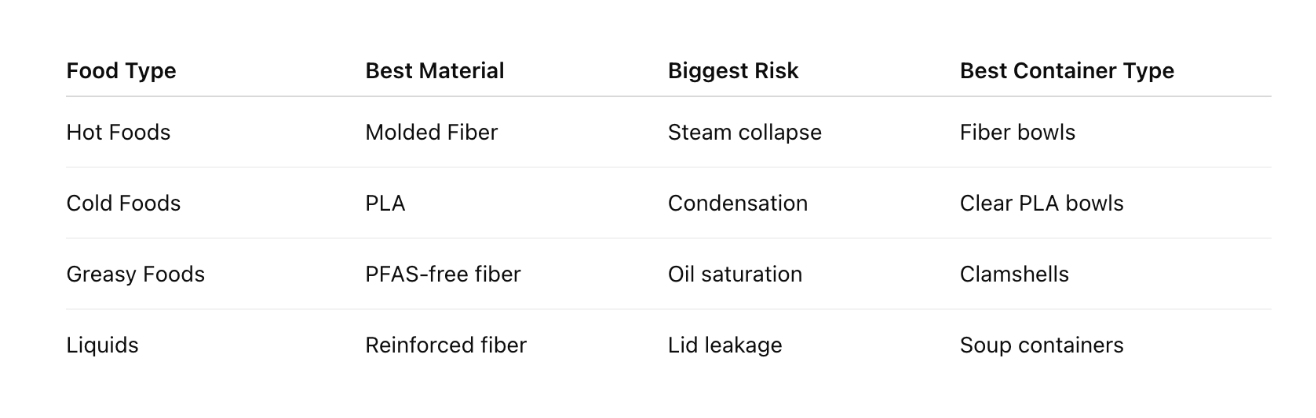
Quick reference guide below:
Sources
1- BPI Compostability Certification Standards, https://bpiworld.org/compostability-certification
2- EPA PFAS Information and Regulatory Overview, https://www.epa.gov/pfas/pfas-explained